Legends of the Map
← All battles

The Ten Days That Saved the Revolution

25 December 1776 – 3 January 1777 · New Jersey and the Delaware River

Plan of the battle: The Ten Days That Saved the Revolution, 25 December 1776 – 3 January 1777

The video is not published yet.

On 20 December 1776 Washington warned Congress that “ten days more will put an end to the existence of our Army”[1]. When most enlistments ran out at the end of the month, he expected to have fourteen to fifteen hundred effective men[6][15]. Within two weeks that army beat the British twice[10][20].

The enemy knew

The British held New Jersey with a chain of winter posts. Howe admitted the chain was “rather too extensive”, but judged his troops safe[23]. Colonel Johann Rall, at Trenton, was warned many times in writing[23][24].

Trenton

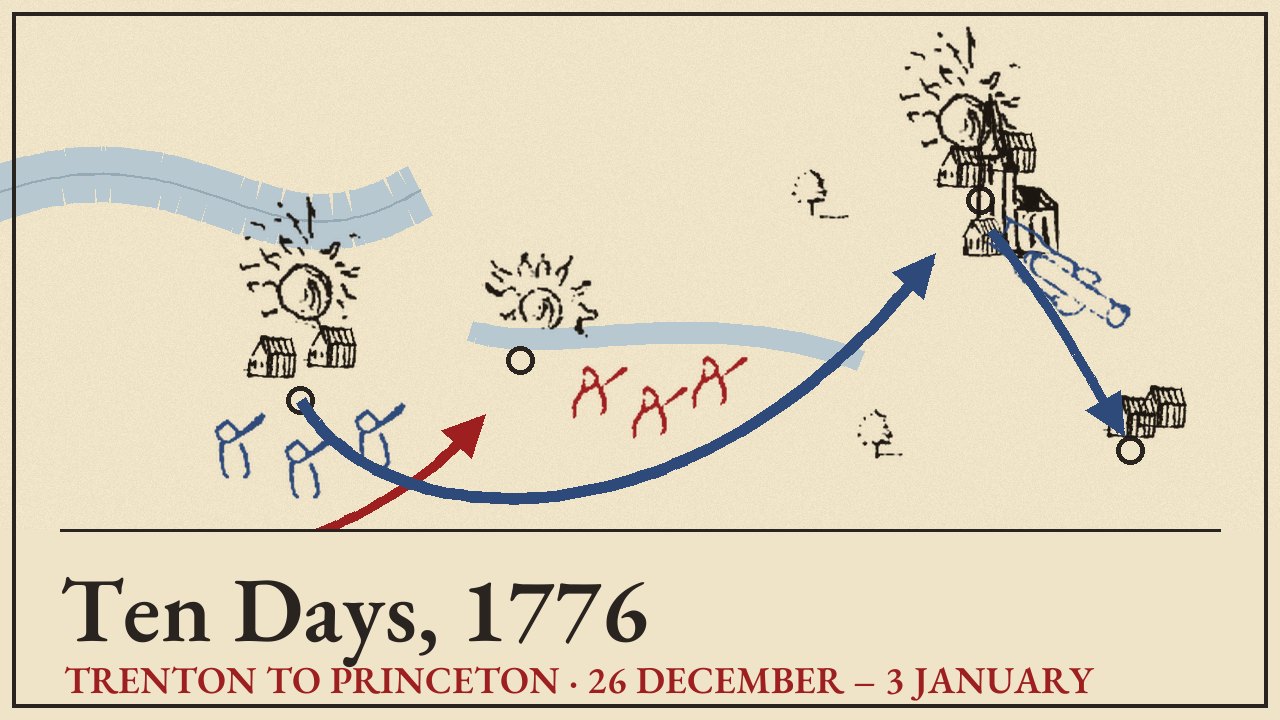
On Christmas night Washington crossed the Delaware above Trenton with about 2,400 men[21]. The ice made him hours late, but he “determined to push on at all Events”. The other two crossings, under Ewing and Cadwalader, failed[10]. On 26 December his column took Rall’s brigade, about 1,500 men. Twenty-three officers and 886 men surrendered, and went back over the river with him that day[10][23].

Paying the army to stay

On 27 December Cadwalader crossed anyway. By the 29th he was at Bordentown with about 1,800 men[26][12]. Washington crossed back into New Jersey too. But “Tomorrow the Continental Troops are all at Liberty,” he wrote to Robert Morris on 31 December[17].

He promised ten dollars a man to troops who would stay six weeks longer[15]. He did not have the money: “we have not Money to pay the Bounty, & we have exhausted our Credit”[17]. On 1 January Morris wrote that he was sending fifty thousand dollars[18].

On 30 December, in a letter meant to sway other regiments, Washington claimed that the New England regiments had “to a Man agreed”[15]. On 1 January he told Congress that “half or a greater proportion” had consented, after “the exertions of their Officers”. “The Troops felt their importance, and would have their price”[19].

At Crosswicks, a militia sergeant’s journal records General Mifflin persuading the New England men to stay[27]. The famous scene of Washington himself winning over silent ranks comes from a memoir written in 1832[30].

The Assunpink

By 1 January Lord Cornwallis had gathered the British at Princeton[23][24]. Washington held Trenton behind Assunpink Creek, the Delaware at his back, and Cadwalader and Mifflin brought about 3,600 more[20]. On 2 January Cornwallis marched down. Colonel Edward Hand’s riflemen delayed him until late afternoon[53][45][20]. The British tried to force the bridge, barely sixteen feet wide, and were driven back each time[21][26]. The sources used here give no reliable count of the losses[24][45].

Cornwallis decided to renew the attack in the morning[25]. The famous story of him boasting that he would catch Washington at dawn first appears in histories written decades later[34][35].

The night march

Washington saw that the enemy meant “to surround us”[20]. Cadwalader’s spy had brought a rough sketch of the road and found no sentries on the east side of Princeton[16]. Around midnight the army left its fires burning and guards at the bridge, and slipped away by a roundabout road to Princeton[20][23]. The ground had frozen hard for a march of about sixteen miles[26]. Washington said it “would avoid the appearance of a retreat”[20]. Even his men were in the dark: “no one knew what the Gen. meant to do,” wrote Captain Thomas Rodney[26].

Princeton

On the morning of 3 January, two British regiments under Lieutenant Colonel Mawhood were marching out of Princeton to join Cornwallis. They met General Hugh Mercer’s brigade by an orchard[26][51][23]. Mercer’s men broke. Mercer was mortally wounded, and died on 12 January[26][48]. Cadwalader’s militia came up and broke too[26][23].

Washington rode in and “exposed himself very much”, one officer wrote[23]. Rodney credits Washington with rallying both brigades, and the British line gave way[26]. Henry Knox wrote that the enemy were “as much astonished as if an army had dropped perpendicularly upon them”[23]. British losses are disputed. By most counts they were a few hundred, mostly prisoners[21][23][47].

After

Washington thought of striking the British stores at Brunswick, but his men were exhausted. He gave it up, fearing “the danger of loosing the advantage we had gained by aiming at too much”[20]. The British fell back toward Brunswick in haste[24]. Knox wrote: “The enemy were within nineteen miles of Philadelphia, they are now sixty miles”[23]. On 20 January Howe admitted that Trenton “has thrown us further back than was at first apprehended”[23].

Key facts

Short answers, each with its source.

When were the Ten Days?
The campaign ran from the night of 25 December 1776, when Washington crossed the Delaware, to the battle at Princeton on 3 January 1777.[10][26]
How many men crossed the Delaware with Washington?
About 2,400 men crossed the river above Trenton on the night of 25 December 1776.[21]
How many Hessians were taken at Trenton?
Washington’s column took Rall’s brigade of about 1,500 men. Twenty-three officers and 886 men surrendered on 26 December 1776.[10][23]
Why did the army nearly break up?
Most enlistments ended with the year. Washington feared he would have only fourteen to fifteen hundred effective men, so he promised ten dollars a man to those who stayed six weeks longer.[6][15]
What did the campaign achieve?
Within two weeks Washington’s army beat the British twice, and the British fell back toward Brunswick. He gave up a strike on their stores to keep what he had gained.[10][20][24]

Sources

Primary sources are from the time. Secondary sources are later accounts.

  1. PrimaryGeorge Washington to John Hancock, 20 December 1776 (letter as sent; PGW Revolutionary War Series vol. 7), Founders Online, National Archives, doc. 03-07-02-0305Accessed 2026-10-17↩
  2. PrimaryColonel Joseph Reed to George Washington, 22 December 1776, The Papers of George Washington, Revolutionary War Series vol. 7, Founders Online, National Archives, doc. 03-07-02-0324Accessed 2026-10-17
  3. PrimaryGeorge Washington to Colonel Joseph Reed, 23 December 1776 (with source note), The Papers of George Washington, Revolutionary War Series vol. 7, Founders Online, National Archives, doc. 03-07-02-0329Accessed 2026-10-17
  4. PrimaryGeorge Washington to John Hancock, Head Quarters at Keith's, 16 December 1776 (letter as sent: LS in Robert Hanson Harrison's writing, DNA:PCC), PGW Revolutionary War Series vol. 7, Founders Online, National Archives, doc. 03-07-02-0280Accessed 2026-10-17
  5. PrimaryGeorge Washington to Robert Morris, 22 December 1776 (ALS, CSmH), PGW Revolutionary War Series vol. 7, Founders Online, National Archives, doc. 03-07-02-0322Accessed 2026-10-17
  6. PrimaryGeorge Washington to John Hancock, 24 December 1776, Founders Online, National Archives, doc. 03-07-02-0338Accessed 2026-10-17↩
  7. PrimaryGeneral Orders, 25 December 1776 (the attack orders, with editorial notes), Founders Online, National Archives, doc. 03-07-02-0341Accessed 2026-10-17
  8. PrimaryGeorge Washington to Colonel John Cadwalader, McKonkey's Ferry, 25 December 1776, 6 P.M., Founders Online, National Archives, doc. 03-07-02-0343Accessed 2026-10-17
  9. PrimaryGeorge Washington to Robert Morris, 25 December 1776, Founders Online, National Archives, doc. 03-07-02-0344Accessed 2026-10-17
  10. PrimaryGeorge Washington to John Hancock, 27 December 1776 (letter and editorial notes), The Papers of George Washington, Revolutionary War Series vol. 7, Founders Online, National Archives, doc. 03-07-02-0355Accessed 2026-10-17↩
  11. PrimaryGeneral Orders, 27 December 1776, The Papers of George Washington, Revolutionary War Series vol. 7, Founders Online, National Archives, doc. 03-07-02-0351Accessed 2026-10-17
  12. PrimaryGeorge Washington to John Hancock, 29 December 1776, Founders Online, National Archives, doc. 03-07-02-0371Accessed 2026-10-17↩
  13. PrimaryGeorge Washington to Robert Morris, 30 December 1776 (hard money 'to pay a certain set of People'; PGW and Fitzpatrick identify them as spies), Founders Online, National Archives, doc. 03-07-02-0382Accessed 2026-10-17
  14. PrimaryRobert Morris to George Washington, 30 December 1776 (second letter of that date, with the letter-book account of the hard money sent: 410 milled dollars and other coin), Founders Online, National Archives, doc. 03-07-02-0384Accessed 2026-10-17
  15. PrimaryGeorge Washington to the Commanding Officer at Morristown, 30 December 1776, Founders Online, National Archives, doc. 03-07-02-0385Accessed 2026-10-17↩
  16. PrimaryColonel John Cadwalader to George Washington, Crosswicks, 31 December 1776 (the spy's report on Princeton), Founders Online, National Archives, doc. 03-07-02-0386Accessed 2026-10-17↩
  17. PrimaryGeorge Washington to Robert Morris, 31 December 1776, Founders Online, National Archives, doc. 03-07-02-0389Accessed 2026-10-17↩
  18. PrimaryRobert Morris to George Washington, 1 January 1777 (fifty thousand dollars dispatched), Founders Online, National Archives, doc. 03-07-02-0402Accessed 2026-10-17↩
  19. PrimaryGeorge Washington to John Hancock, 1 January 1777 (letter as sent, with postscript; PGW notes the draft's differences), Founders Online, National Archives, doc. 03-07-02-0398Accessed 2026-10-17↩
  20. PrimaryGeorge Washington to John Hancock, Pluckemin, 5 January 1777 (letter as sent; PGW notes the draft's differences), Founders Online, National Archives, doc. 03-07-02-0411Accessed 2026-10-17↩
  21. PrimaryJohn C. Fitzpatrick, ed., The Writings of George Washington from the Original Manuscript Sources, vol. 6 (Sept 1776 - Jan 1777) (Washington, D.C.: GPO, 1932), letters of 18 Dec 1776 - 7 Jan 1777 with editorial notes. Full text read on Internet Archive.Accessed 2026-10-17↩
  22. PrimaryDeclaration of Independence, 4 July 1776: A Transcription, National Archives (America's Founding Documents)Accessed 2026-10-17
  23. SecondaryWilliam S. Stryker, The Battles of Trenton and Princeton (Boston: Houghton Mifflin, 1898). Part II prints the documents: Howe-Donop-Grant-Rall correspondence (Nos. 5-26), Knox's letters (Nos. 85, 95), the 'Officer of Distinction' letter (No. 93), Howe's returns and dispatches (Nos. 99, 118), the Hessian courts of inquiry (Nos. 70-72), Inman (No. 114) and Joseph White (No. 115). Full text read on Internet Archive.Accessed 2026-10-17↩
  24. PrimaryJohann Ewald, Diary of the American War: A Hessian Journal, trans. and ed. Joseph P. Tustin (New Haven: Yale University Press, 1979), entries for 20 Dec 1776 - 4 Jan 1777. Read on Internet Archive.Accessed 2026-10-17↩
  25. SecondaryCharles Stedman, The History of the Origin, Progress, and Termination of the American War, vol. 1 (London, 1794). Read on Internet Archive.Accessed 2026-10-17↩
  26. PrimaryCaesar A. Rodney, ed., Diary of Captain Thomas Rodney, 1776-1777 (Wilmington: Historical Society of Delaware, 1888), entries 25 Dec 1776 - 4 Jan 1777, pp. 22-38. Read on Internet Archive.Accessed 2026-10-17↩
  27. Primary'Journal of Sergeant William Young, Written During the Jersey Campaign in the Winter of 1776-7', Pennsylvania Magazine of History and Biography 8 (1884), pp. 255-278. Read on Internet Archive (JSTOR Early Journal Content).Accessed 2026-10-17↩
  28. PrimaryJames Wilkinson, Memoirs of My Own Times, vol. 1 (Philadelphia: Abraham Small, 1816), chapters on Trenton and PrincetonAccessed 2026-10-17
  29. PrimaryJohn Greenwood, The Revolutionary Services of John Greenwood of Boston and New York, 1775-1783 (New York, 1922), written from memory in 1809. Read on Internet Archive.Accessed 2026-10-17
  30. Primary'The Battle of Princeton, by Sergeant R—', from The Phenix (Wellsborough, Pa.), 24 March 1832, reprinted in Pennsylvania Magazine of History and Biography 20 (1896), pp. 515-519. Read on Internet Archive (JSTOR Early Journal Content).Accessed 2026-10-17↩
  31. PrimaryEdwin M. Stone, ed., The Life and Recollections of John Howland (Providence, 1857), pp. 69-77. Read on Internet Archive.Accessed 2026-10-17
  32. PrimaryBenjamin Rush, A Memorial Containing Travels Through Life (ed. Louis A. Biddle, 1905), p. 94; Rush's manuscript dated c. 1800. Read on Internet Archive.Accessed 2026-10-17
  33. PrimaryThomas Paine, The American Crisis, No. 1 (Philadelphia, Dec 1776), in The Writings of Thomas Paine, ed. M. D. Conway, vol. 1, Project Gutenberg e-text 3741Accessed 2026-10-17
  34. SecondaryBenson J. Lossing, The Pictorial Field-Book of the Revolution, vol. 2 (New York, 1852), pp. 233-234. Read on Internet Archive.Accessed 2026-10-17↩
  35. SecondaryWashington Irving, Life of George Washington, vol. 2 (New York, 1855), pp. 473-474. Read on Internet Archive.Accessed 2026-10-17↩
  36. SecondaryAmerican Battlefield Trust, 'Lexington and Concord' (battle page)Accessed 2026-10-17
  37. SecondaryAmerican Battlefield Trust, 'Bunker Hill' (battle page, with casualty table)Accessed 2026-10-17
  38. SecondaryAmerican Battlefield Trust, 'Brooklyn' (Battle of Long Island, battle page, with strength and casualty table)Accessed 2026-10-17
  39. SecondaryAmerican Battlefield Trust, 'Forts Washington and Lee' (article)Accessed 2026-10-17
  40. Secondary'Siege of Boston', Digital Encyclopedia, George Washington's Mount VernonAccessed 2026-10-17
  41. Secondary'Henry Knox', Digital Encyclopedia, George Washington's Mount VernonAccessed 2026-10-17
  42. SecondaryDavid Head, 'Hessians', Digital Encyclopedia, George Washington's Mount VernonAccessed 2026-10-17
  43. SecondaryNational Park Service, 'Nathanael Greene' (people page)Accessed 2026-10-17
  44. SecondaryAmerican Battlefield Trust, 'The Ten Crucial Days' (series overview)Accessed 2026-10-17
  45. SecondaryAmerican Battlefield Trust, 'The Ten Crucial Days: A Second Success at Trenton' (updated 21 Dec 2023)Accessed 2026-10-17↩
  46. SecondaryAmerican Battlefield Trust, 'The Ten Crucial Days: Princeton'Accessed 2026-10-17
  47. SecondaryAmerican Battlefield Trust, 'Princeton: Battle Facts and Summary'Accessed 2026-10-17↩
  48. SecondaryAmerican Battlefield Trust, '10 Facts: Battle of Princeton'Accessed 2026-10-17↩
  49. SecondaryCody Lass (updated by Zoie Horecny, 10 Apr 2025), 'Battle of Trenton', Digital Encyclopedia, George Washington's Mount VernonAccessed 2026-10-17
  50. SecondaryJoseph F. Stoltz III, 'Battle of Second Trenton', Digital Encyclopedia, George Washington's Mount VernonAccessed 2026-10-17
  51. SecondaryJoseph F. Stoltz III, 'Battle of Princeton', Digital Encyclopedia, George Washington's Mount VernonAccessed 2026-10-17↩
  52. SecondaryGeorge Washington's Mount Vernon, '10 Facts about the Battle of Princeton'Accessed 2026-10-17
  53. SecondaryDavid Price, 'Edward Hand's American Journey', Journal of the American Revolution (May 2022)Accessed 2026-10-17↩
  54. Secondary'Hugh Mercer: Doctor and Warrior', Journal of the American Revolution (Jan 2017)Accessed 2026-10-17
  55. Secondary'Johann Gottlieb Rall: Tactical Negligence or Personal Negligence at Trenton?', Journal of the American Revolution (Feb 2023)Accessed 2026-10-17
  56. SecondaryWilliam Conner, 'The American Crisis Before Crossing the Delaware?', Journal of the American Revolution (25 Feb 2015)Accessed 2026-10-17
  57. Secondary'A Brief Publication History of the "Times That Try Men's Souls"', Journal of the American Revolution (Jan 2016)Accessed 2026-10-17
  58. Secondary'That Chess Story', Emerging Revolutionary War (3 Jun 2026)Accessed 2026-10-17
  59. SecondaryPrinceton University Archives (Mudd Library blog), 'Alexander Hamilton shooting the cannonball that destroys the portrait of King George' (Jan 2008), quoting the Trustees' minutes of 1783Accessed 2026-10-17
  60. SecondaryVirginia Kays Creesy, 'The Battle of Princeton', Princeton Alumni Weekly (1976, republished online 2016)Accessed 2026-10-17
  61. SecondaryEd Redmond, 'Connecting Collections: The Battle of Trenton and Princeton', Worlds Revealed (Library of Congress Geography and Map Division blog), 19 Dec 2018Accessed 2026-10-17
  62. PrimaryColonel John Cadwalader to George Washington, 26 December 1776 (two letters, docs. 03-07-02-0347 and 0348, with editorial notes quoting Reed, Rodney and Christopher Marshall), Founders Online, National ArchivesAccessed 2026-10-18
  63. PrimaryColonel John Cadwalader to George Washington, 27 December 1776, Founders Online, National Archives, doc. 03-07-02-0353Accessed 2026-10-18
  64. PrimaryWorthington C. Ford, ed., Journals of the Continental Congress, 1774-1789, vol. 6 (Oct-Dec 1776) (Washington: GPO, 1906), pp. 1015, 1026-1032. Read on Internet Archive.Accessed 2026-10-18
  65. Primary'Distribution of the Troops in New Jersey Commanded by Major General Grant, December 16, 1776, Head Quarters Brunswick', British Library Add. MS 21,687 f. 321 (Haldimand Papers), transcribed by Todd Braisted, The On-Line Institute for Advanced Loyalist StudiesAccessed 2026-10-18
  66. PrimaryWilliam James Morgan, ed., Naval Documents of the American Revolution, vol. 7 (Washington: Naval History Division, 1976), Dec 1776 - Jan 1777. Read on Internet Archive.Accessed 2026-10-18
  67. SecondaryMax von Eelking, Memoirs, and Letters and Journals, of Major General Riedesel, trans. William L. Stone, vol. 1 (Albany: J. Munsell, 1868). Read on Internet Archive.Accessed 2026-10-18
  68. SecondaryOpenStreetMap contributors, Nominatim and Photon geocoders (place coordinates queried 2026-10-18)Accessed 2026-10-18

↑ Back to top